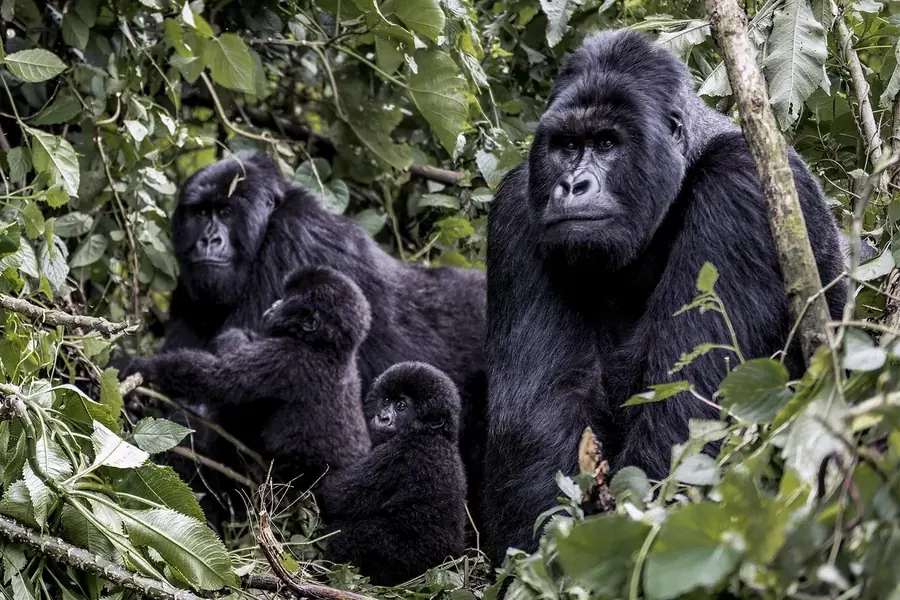
Uganda has two national parks where you can trek mountain gorillas: Bwindi Impenetrable National Park and Mgahinga Gorilla National Park. Both charge $800 for a permit. Both deliver one extraordinary hour with wild mountain gorillas. But they are remarkably different experiences — and knowing which one is right for you matters.
The Short Answer
For most visitors, and especially for first-time gorilla trekkers, Bwindi is the better choice. It has more than 19 habituated gorilla families across four sectors, giving you far more flexibility in scheduling. It offers a wider range of accommodation from budget guesthouses to world-class luxury lodges. Permits are easier to book. And the permit cancellation risk — which has historically been a real concern with Mgahinga — is essentially zero in Bwindi.
But Mgahinga is not a consolation prize. It is a genuinely special place that delivers a different kind of experience: a volcanic landscape unlike any other in Uganda, golden monkeys as a bonus activity, and a sense of remote wilderness that Bwindi's four-sector infrastructure cannot quite replicate. For experienced wildlife travellers, repeat visitors, or those with a specific passion for the Virunga volcanic ecosystem, Mgahinga is not just acceptable — it is the right choice.
Here is the full picture.
Bwindi Impenetrable National Park: The Essentials
Bwindi Impenetrable National Park is located in southwestern Uganda in the Albertine Rift Valley, covering 331 square kilometres of ancient tropical rainforest. It is one of the most biologically diverse forests on the continent — a fact confirmed by its dual UNESCO World Heritage designation for both its biodiversity and its mountain gorilla population.
Bwindi was formally opened for gorilla trekking tourism in 1993. In the more than three decades since, it has developed into one of Africa's premier wildlife tourism destinations, with a sophisticated infrastructure of trained guides, established trails, diverse accommodation, and conservation management that is widely studied as a model for community-based wildlife conservation.
The park contains more than 19 habituated gorilla families, distributed across four sectors:
- Buhoma (north) — the original and most established sector; home to the Mubare, Habinyanja, Rushegura, and Katwe families; excellent accommodation options from mid-range to luxury; most accessible from Kampala via the western route
- Rushaga (south) — the largest sector with the most gorilla families; the only sector offering the Gorilla Habituation Experience ($1,500); families include Nshongi, Kahungye, Mishaya, Busingye, and others; closest sector to Mgahinga and the Kigali road
- Nkuringo (southwest) — dramatic ridgeline scenery, steep terrain, slightly fewer visitors; famous for Clouds Mountain Gorilla Lodge, one of Africa's most awarded wilderness lodges
- Ruhija (east) — highest altitude sector, excellent for both gorilla trekking and Albertine Rift endemic birding; quieter than Buhoma and Rushaga; Gorilla Highlands family
This four-sector structure means Bwindi can accommodate a large number of visitors without any single trail or family becoming overcrowded. On any given day across all sectors, over 100 permits may be active. The families are widely distributed, the trails are maintained, and the logistics are well-established.
Mgahinga Gorilla National Park: The Essentials
Mgahinga Gorilla National Park sits in the far southwest corner of Uganda, on the slopes of the Virunga volcanoes at the junction of Uganda, Rwanda, and the Democratic Republic of Congo. At 33.7 square kilometres, it is Uganda's smallest national park — smaller than a modest city suburb — but it contains ecosystems found nowhere else in Uganda: montane bamboo forest, Afro-alpine moorland, and the dramatic volcanic peaks of Muhavura (4,127m), Gahinga (3,474m), and Sabinyo (3,645m).
Mgahinga has exactly one habituated gorilla family: the Nyakagezi family, which as of 2026 has approximately 10 members including at least two silverbacks. Only 8 trekking permits per day are issued, making each permitted trek group feel exceptionally small and intimate.
The park opened for gorilla trekking in the early 1990s alongside Bwindi, but its development has been slower and its tourism infrastructure more limited. This is simultaneously its greatest limitation and — for certain travellers — its most powerful appeal.
Head-to-Head Comparison
| Factor |
Bwindi |
Mgahinga |
| Habituated gorilla families |
19+ families across 4 sectors |
1 family (Nyakagezi, ~10 members) |
| Daily permits issued |
8 per family; many families = much higher total |
8 permits total (entire park) |
| Permit price |
$800 per person |
$800 per person |
| Gorilla habituation experience |
Yes (Rushaga sector, $1,500) |
No |
| Trek duration (typical) |
2–8 hours (highly variable by family location) |
Often shorter; family frequently near park boundary |
| Permit cancellation risk |
Very low (families stay within park) |
Low-moderate (Nyakagezi crosses into Rwanda/DRC) |
| Landscape character |
Ancient tropical rainforest |
Volcanic landscape, bamboo, moorland |
| Golden monkey trekking |
Not available |
Yes ($100, 1 hour) |
| Volcano hiking |
Not available |
Yes (Muhavura, Gahinga, Sabinyo) |
| Accommodation range |
Budget to ultra-luxury (wide choice) |
Limited; mostly mid-range options |
| Distance from Kampala |
~8–10 hours by road (Buhoma/Rushaga) |
~9–11 hours by road (or 2–3 hours from Kigali) |
| Overall trekking difficulty |
Steep and demanding; varies by sector |
Steep; often shorter overall trek time |
The Nyakagezi Family: Unique in the World
The Nyakagezi gorilla family is one of the most unusual habituated gorilla families anywhere. Unlike Bwindi's families — which are contained within the park boundaries and have well-established home ranges — the Nyakagezi family has a home range that crosses the borders of three countries: Uganda, Rwanda, and the Democratic Republic of Congo. They move through the Virunga Massif following food sources, elevation patterns, and social dynamics that do not recognise international boundaries.
For years, this transboundary movement was the principal frustration with Mgahinga. Visitors would arrive with valid permits only to be told that the Nyakagezi family was currently in Rwanda or the DRC and could not be reached from the Ugandan side. Permit cancellations were genuinely common. UWA tracking teams have significantly improved their ability to monitor the family's real-time location using radio collars on selected individuals, and permit cancellations due to transboundary movement are now far less frequent — but they have not been eliminated entirely.
If your travel dates are fixed and inflexible, this residual risk matters. If your gorilla trek is a once-in-a-decade trip planned around specific travel windows, and if a cancellation would be devastating, Bwindi is the safer choice. But if you have some flexibility, or if the idea of tracking a gorilla family that genuinely belongs to no single country is itself part of the appeal — that is a perspective worth entertaining.
The Nyakagezi family currently has at least two silverbacks, along with adult females, sub-adults, and juveniles. Multi-silverback groups are more dynamic and their interactions more complex and visually dramatic than single-silverback groups. When the two silverbacks are both visible — displaying, interacting, or simply feeding near each other — the hour you are allowed goes past in a way that makes it feel like five minutes.
Golden Monkeys in Mgahinga: A Unique Bonus
One of Mgahinga's most compelling and underappreciated features is that it is one of the only places in the world where you can trek golden monkeys — a genuinely extraordinary primate that most visitors have never heard of before arriving in the Virunga region.
Golden monkeys (Cercopithecus kandti) are endemic to the Virunga Massif and the Gishwati Forest in Rwanda. In Uganda, they are found exclusively in Mgahinga. A golden monkey trekking permit costs $100 per person and gives you one hour with a habituated group in Mgahinga's bamboo forest zone.
The name is not hyperbole. Golden monkeys have a vivid golden-orange patch on their backs and flanks that contrasts sharply against their black limbs and head. They are highly acrobatic, social, and vocal — leaping through bamboo canopy, calling, grooming, feeding, and occasionally descending to the forest floor. They are smaller than chimpanzees and considerably more agile. Watching a habituated group in Mgahinga's bamboo forest is a genuinely different experience from any other primate encounter in East Africa.
If you are visiting Mgahinga for gorilla trekking, adding a golden monkey trek the following morning for $100 is an obvious decision. No other park in Uganda offers this.
"You come to Mgahinga for one gorilla family and you leave having also spent a morning with golden monkeys in bamboo forest with three volcanoes above you. That combination does not exist anywhere else in Uganda."
Michael Wamani, Senior Safari Guide, TRVE
Volcano Hiking in Mgahinga
Mgahinga's three Virunga volcanoes offer a hiking experience entirely different from anything available in Bwindi. Mount Muhavura (4,127 metres) is the highest of the three Ugandan Virunga peaks and rewards a full-day summit hike with views across the volcanic chain into Rwanda and the DRC on clear days. Mount Gahinga is a shorter climb through bamboo and Afro-alpine zones to its crater and crater lake. Mount Sabinyo — shared between Uganda, Rwanda, and the DRC — offers a dramatic ridgeline traverse with three separate summit peaks, each of which straddles a different international border.
These are not casual walks. Volcano hiking in Mgahinga requires good fitness, appropriate footwear, and a guide (mandatory through UWA). But for travellers who want to add a physical challenge and extraordinary landscapes to their gorilla and golden monkey experience, Mgahinga can accommodate a full three-day programme: gorilla trekking, golden monkey trekking, and a volcano summit.
None of this is possible in Bwindi, which is flat-topped forest terrain rather than volcanic landscape.
Accommodation: A Significant Practical Difference
Bwindi's accommodation range is one of its genuine strengths. Across its four sectors, you can find clean, well-run budget guesthouses for $80–$120 per night, comfortable mid-range lodges for $200–$400 per night, and world-class luxury properties — Bwindi Lodge, Clouds Mountain Gorilla Lodge, Sanctuary Gorilla Forest Camp, Mahogany Springs, Gorilla Safari Lodge — that compete with the best safari accommodation anywhere on the continent at $500–$1,200+ per night.
Mgahinga's accommodation situation is more constrained. The park's small size and limited development means fewer lodges and fewer options at the upper end of the market. Mount Gahinga Lodge is the standout property near Mgahinga — a comfortable, well-managed lodge with individual bandas and a pleasant atmosphere — but the luxury range available in Bwindi does not have a Mgahinga equivalent. Budget and mid-range options are available in the nearby town of Kisoro, which is approximately 14 kilometres from the park gate.
For travellers whose lodge experience is central to the trip, Bwindi offers significantly more to choose from. For travellers who are primarily here for the trekking and are comfortable with mid-range accommodation, Mgahinga's options are perfectly adequate.
Combining Mgahinga with a Rwanda Itinerary
Mgahinga's geography creates a travel itinerary option that Bwindi cannot offer: combining Uganda gorilla trekking with Rwanda's Volcanoes National Park in a single efficient journey. Mgahinga is only 2–3 hours from Kigali by road (compared to 8–10 hours from Kampala), making it practical to fly into Kigali, spend time in Rwanda's Volcanoes NP for gorilla or golden monkey trekking, cross the border to Mgahinga for Uganda gorilla trekking, and then continue overland to Bwindi or fly back from Entebbe.
This "Virunga Loop" itinerary is genuinely compelling for travellers who want to compare the experience of trekking gorillas in both Uganda and Rwanda. Rwanda's Volcanoes NP gorilla permit costs $1,500 (vs Uganda's $800), but the volcanic landscape and the well-organised Rwanda tourism infrastructure create a distinctly different feel. Gorilla families in Volcanoes NP tend to be found at higher altitude and in more open bamboo terrain; Bwindi and Mgahinga's families are typically in denser forest.
If a combined Uganda-Rwanda gorilla itinerary interests you, Mgahinga — not Bwindi — is the logical Uganda anchor for this trip. We can build this itinerary as a custom package. Contact us to discuss.
The TRVE Verdict: Who Should Go Where
Our Recommendation
First-time gorilla trekker: Bwindi. More families, more availability, more accommodation choice, zero cancellation risk.
Experienced wildlife traveller seeking something different: Mgahinga. One family, volcanic setting, golden monkeys, volcano hiking — a genuinely unique combination.
Traveller combining Uganda and Rwanda: Mgahinga as the Uganda component. Proximity to Kigali makes the logistics sensible, and the Virunga setting creates continuity between the two countries' gorilla experiences.
Birder or nature photographer: Bwindi (specifically Ruhija sector) for the widest range of Albertine Rift endemic species. Mgahinga's limited size means fewer birding habitats.
Adventure traveller wanting a full multi-activity programme: Mgahinga. Gorillas + golden monkeys + volcano hiking in a small, remote park creates an intensity of experience that a single Bwindi sector cannot match.
Which TRVE Packages Include Bwindi and Mgahinga
The majority of TRVE gorilla packages are built around Bwindi — reflecting both its greater capacity and the preferences of most of our clients. Our Gorilla Trek Classic is a focused 5-day Bwindi experience in the mid-range tier. Our Big Seven Quest combines Bwindi with savannah game parks for a comprehensive Uganda wildlife itinerary. Our Primate Triangle package combines Bwindi gorilla trekking with Kibale chimpanzee trekking and a game drive in Queen Elizabeth National Park.
Mgahinga is available as a destination on request and can be incorporated into custom itineraries — particularly for clients combining Uganda with Rwanda, or those specifically interested in the golden monkey experience and Virunga volcanic landscape. We do not currently run a standard Mgahinga package, but we can build a custom 3–5 day Mgahinga programme including gorilla trekking, golden monkey trekking, and volcano hiking for the right client.
If Mgahinga interests you after reading this guide, contact us directly. We will discuss your travel dates, confirm Nyakagezi family permit availability for your preferred window, and design an itinerary that makes the most of everything this small and remarkable park offers.
Final Note: Two Parks, One Species, Different Worlds
Mountain gorillas exist in only one place on earth — the forests and volcanic slopes of the Albertine Rift. Whether you encounter them in Bwindi's ancient rainforest or on the lower slopes of Mgahinga's volcanoes, the core experience is the same: one hour with a wild mountain gorilla family, close enough to hear them breathe, watch them feed, and see an infant cling to its mother's back. No screen, no zoo, no documentary prepares you for it.
The choice between Bwindi and Mgahinga is ultimately a question of what kind of journey you want around that hour. Bwindi offers more families, more infrastructure, more accommodation, and more flexibility. Mgahinga offers a wilder, more remote, more volcanically dramatic setting, with golden monkeys and summit hikes as unique bonuses.
Both are magnificent. Choose the one that fits your trip — and if you are not sure, ask us. That is what we are here for.