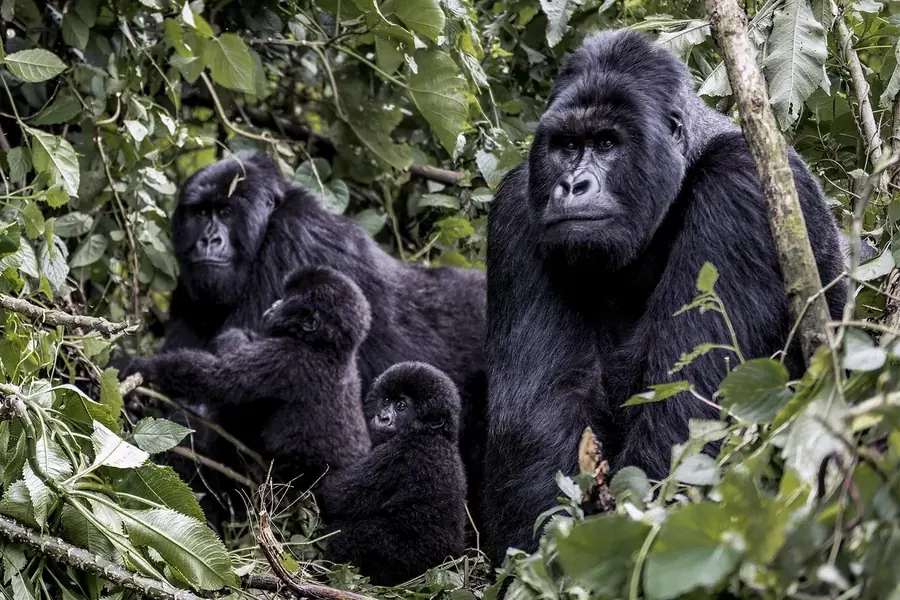
There is nothing else on earth quite like standing in the green half-light of Bwindi Impenetrable Forest and watching a silverback mountain gorilla move through the undergrowth five metres away. These are not animals in a zoo. They are wild, entirely free, living out their lives in one of Africa's most ancient and biologically extraordinary forests — and for one hour, you are a guest in their world.
Why Bwindi Is in a Category of Its Own
Bwindi Impenetrable National Park sits in the extreme southwest of Uganda, pressed against the borders of the Democratic Republic of Congo and Rwanda. It covers 331 square kilometres of unbroken Afromontane rainforest, rising from 1,160 metres at its lowest valley floors to 2,607 metres at its highest peaks. The forest is dense, steep, and ancient — geologists believe it survived the last ice age as a refugium, which explains why it harbours such exceptional biodiversity: more than 120 species of mammal, 350 species of bird, and over 1,000 plant species recorded within its boundaries.
In 1994, UNESCO designated Bwindi a World Heritage Site, recognising both its exceptional ecological value and its role as the primary stronghold of the mountain gorilla (Gorilla beringei beringei). As of the most recent survey, approximately 460 mountain gorillas — roughly half the world's entire population — live within Bwindi's forests. The other half live in the Virunga Massif, shared between DRC, Rwanda, and Uganda. Unlike eastern lowland gorillas or western gorillas, mountain gorillas have never survived in captivity. The only way to see one is to go to them.
That irreplaceable fact is what makes a Bwindi trek more than a wildlife encounter. It is one of the rarest, most intimate wildlife experiences available anywhere on the planet.
Bwindi at a Glance
- Location: Southwestern Uganda, Kanungu & Kabale Districts
- Area: 331 km² of Afromontane rainforest
- Altitude: 1,160 – 2,607 metres above sea level
- UNESCO World Heritage: Designated 1994
- Mountain gorillas: ~460 individuals (~half the world population)
- Habituated gorilla families: Over 20, spread across four sectors
- Gorilla permit: $800 USD per person (foreign non-resident)
- Nearest airport: Kihihi Airstrip (Buhoma) or Kisoro Airstrip (Rushaga/Nkuringo)
- Drive from Kampala: 8–9 hours via Mbarara
The Four Trekking Sectors
Bwindi is divided into four trekking sectors, each with its own character, lodge options, gorilla families, and terrain profile. Choosing the right sector is one of the first and most important decisions you'll make when planning your trek. The table below gives a clear comparison.
| Sector | Best For | Terrain | Special Feature | Nearest Town |
|---|---|---|---|---|
| Buhoma | First-time trekkers, wider lodge range | Moderate — well-established trails, steep but manageable | Most established sector, gateway to the forest, longest operating history | Buhoma village |
| Rushaga | Families, groups, maximum gorilla access | Moderate to steep — varied terrain | Largest number of habituated families; the only sector offering the Gorilla Habituation Experience ($1,500) | Kisoro / Rushaga |
| Nkuringo | Adventurous trekkers, photographers seeking dramatic scenery | Very steep — the most physically demanding sector | Spectacular views across the DRC border; dramatic ridgeline setting | Nkuringo village |
| Ruhija | Birders, repeat visitors, those wanting solitude | Moderate to steep — high-altitude, cooler temperatures | Quietest sector; best birding in Bwindi; home to Albertine Rift endemic species | Ruhija village |
Our recommendation for first-timers: Buhoma or Rushaga. Both have excellent lodge infrastructure, shorter drives from Kampala, and experienced ranger teams who have been guiding treks for over two decades. If you have a particular interest in birding, request Ruhija. If you want the most dramatic photographs, book Nkuringo — but budget for an extra fitness session beforehand.
Understanding the Gorilla Permit
The gorilla trekking permit is the single most important logistical element of your Bwindi experience. Here is what you need to know before you commit.
Cost: $800 USD per person for foreign non-residents. East African Community citizens pay a significantly lower rate. The permit fee is paid to the Uganda Wildlife Authority (UWA) and directly funds gorilla conservation, anti-poaching operations, and community development programmes around the park.
What it includes: One gorilla trek with a UWA ranger team, briefing at the sector headquarters, and exactly one hour in the presence of a habituated gorilla family. The permit does not include accommodation, transport, meals, porter fees, or park entry.
Gorilla Habituation Experience (GHE): Available only in Rushaga sector, the GHE costs $1,500 per person and allows you to spend four hours with a semi-habituated gorilla family — families that are still in the process of becoming accustomed to human presence. The experience is more raw, less predictable, and one of the most extraordinary wildlife encounters available anywhere in Africa. Only four people are permitted per GHE session per day.
Booking: Permits are booked through UWA or through a licensed tour operator like TRVE. Eight permits per habituated gorilla family per day are the maximum allowed — this cap exists to minimise stress on the gorillas and to maintain the quality of the experience for trekkers. During peak season (June–August and December–January), permits sell out many months in advance. We strongly recommend booking at least four to six months ahead for peak dates.
Non-refundable policy: Gorilla permits are non-refundable once issued. If you fall ill on the day of your trek, UWA may offer a reschedule in exceptional circumstances, but this is not guaranteed. Travel insurance with a safari-specific clause is essential.
What Happens on the Day of Your Trek
Understanding the rhythm of a gorilla trekking day removes anxiety and allows you to be fully present for the experience itself.
Morning Briefing — 7:30am
Trekkers gather at the sector headquarters (usually by 7:30am) for a briefing from the head UWA ranger. This covers gorilla etiquette, health protocols, photography guidelines, emergency procedures, and an introduction to the specific family you'll be tracking. Groups are kept to a maximum of eight people per gorilla family. If you have pre-booked multiple permits, TRVE ensures your group is allocated to the same family.
The Trek
Rangers set out at dawn ahead of the trekking group to locate the gorilla family, who will have moved from their sleeping nests overnight. The lead ranger stays in radio contact and guides your group to where the family currently is. The trek itself can take anywhere from 45 minutes to eight hours, depending entirely on gorilla movement — there is no way to predict it. This unpredictability is part of what makes the experience feel genuinely wild. Your ranger team knows the forest intimately and will navigate confidently regardless of conditions.
Porters are available for hire at approximately $20 per trek, payable directly to the porter. This is one of the best $20 you will spend on your entire safari. Porters carry your day pack, provide physical support on steep and slippery terrain, and contribute to community livelihoods around the park. Many are former poachers who have been integrated into the conservation economy — hiring one is a direct act of conservation support.
The One Hour with the Gorillas
When the ranger signals that the family has been located, the group goes quiet. You approach slowly, following the ranger's lead, until the gorillas come into view. For the next sixty minutes — strictly enforced — you remain with the family, observing, photographing (no flash), and attempting to absorb the full improbability of the moment.
Gorillas are largely indifferent to properly habituated human observers, though younger animals may approach out of curiosity and silverbacks occasionally charge — a "bluff charge" intended to assert dominance. Rangers will instruct you to crouch, avoid direct eye contact, and remain still. It passes. A minimum distance of seven metres must be maintained at all times, both to protect the gorillas from human-transmitted diseases (their immune systems have no resistance to common human pathogens) and to ensure a natural interaction.
No flash photography is permitted. A 100–400mm lens will give you frame-filling portraits without needing to reduce the distance. In Bwindi's filtered forest light, a camera with strong low-light performance will serve you better than one optimised for bright conditions.
Fitness and Preparation
Gorilla trekking in Bwindi does not require elite fitness, but it rewards preparation. The forest terrain is steep, often wet, and always unpredictable underfoot. Here is how to prepare:
- Footwear: Waterproof hiking boots with ankle support are essential. Trail runners are not adequate for the conditions in Bwindi's wetter seasons.
- Clothing: Long trousers and long sleeves protect against stinging nettles, insects, and scratches from undergrowth. Lightweight moisture-wicking fabrics are ideal. Avoid blue and black clothing, which can attract tsetse flies.
- Gardening gloves: Genuinely useful for grabbing vegetation on steep ascents and descents. Pack a lightweight pair.
- Gaiters: Useful during the wet seasons when trail mud is deep. Your TRVE guide can advise based on current conditions.
- Day pack: Carry two litres of water minimum, high-energy snacks, sunscreen, insect repellent, and your camera. Nothing else is needed — your lodge will supply a packed lunch.
- Health precautions: If you have a cold, cough, or any respiratory illness on the day of your trek, you will not be permitted to enter the forest. This policy exists to protect the gorillas. Alert your TRVE guide immediately — UWA may offer a reschedule depending on availability.
Packing Checklist for Trek Day
- Waterproof hiking boots (broken in before arrival)
- Long-sleeve shirt and long trousers — neutral earth tones
- Lightweight rain jacket or poncho
- Gardening gloves (inexpensive, invaluable)
- 2 litres of water minimum
- High-energy snacks (nuts, energy bars, fruit)
- Insect repellent (DEET-based for forest conditions)
- Sunscreen (UV is intense at altitude)
- Camera with a 70–300mm or 100–400mm zoom lens
- Fully charged spare battery (no charging in the forest)
- Small first-aid kit with blister plasters
- Cash in small denominations (USD or UGX) for your porter tip
The Best Time to Visit Bwindi
Bwindi is a year-round destination — gorillas do not migrate and can be found in all seasons. However, the season significantly affects trail conditions, lodge prices, and permit availability.
Dry Seasons (June–August and December–February)
The two dry seasons offer the best hiking conditions: trails are firmer, river crossings are easier, and the forest canopy is less dense with moisture. June to August is the busiest and most sought-after period, when international school holidays align with optimal weather. December and January are increasingly popular for honeymoon and Christmas travel. Book permits at least six months in advance for these windows.
Wet Seasons (March–May and October–November)
The long rains (March–May) and short rains (October–November) bring challenges but also rewards. Trails are muddier and treks are harder work, but the forest is spectacularly lush, lodge prices drop by 20–40%, and permit availability is higher. Fewer visitors also means a more intimate experience. Gorillas are still tracked reliably in all wet-season conditions — in fact, some of TRVE's most dramatic gorilla encounters have happened in the rain, when the forest sounds different and the animals seem to move differently through the green light.
If your dates are flexible and budget matters, the shoulder periods — late September and early November — often offer the best balance of conditions and value.