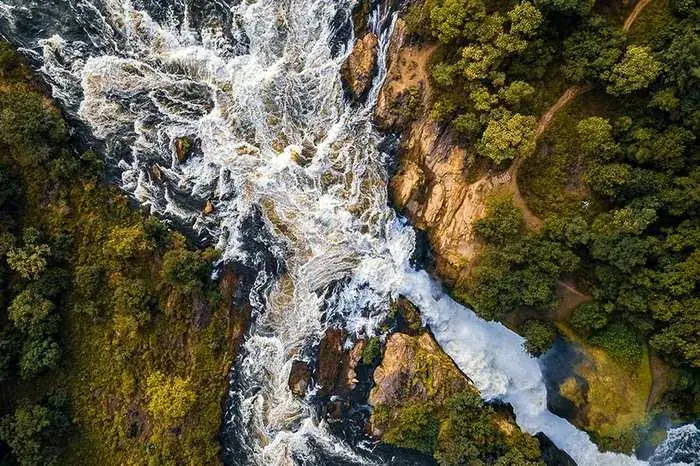
Murchison Falls is where the Nile performs its most spectacular act. The entire volume of the world's longest river — carrying the full drainage of East Africa's Great Lakes — is forced through a seven-metre crack in the earth's surface, exploding upward in a column of white water and spray visible from two kilometres away. Around that extraordinary event, Uganda's largest national park unfolds across 3,840 square kilometres of savanna, woodland, and riverine forest teeming with elephants, giraffes, lions, and some of the most varied birdlife on the continent.
About Murchison Falls National Park
Murchison Falls National Park (MFN) is Uganda's largest protected area, covering 3,840 square kilometres in the northwest of the country, roughly 305 kilometres from Kampala. It is part of the broader Murchison Falls Conservation Area, which includes Bugungu Wildlife Reserve to the south and Karuma Wildlife Reserve to the east, bringing the total protected landscape to over 4,900 square kilometres.
The park is bisected from east to west by the Victoria Nile, which enters at Karuma Falls in the east and flows through the park to drain into Lake Albert at the western boundary. This great river creates a dividing line between two distinct ecosystems: the north bank, where open rolling savanna supports Uganda's highest concentrations of large mammals, and the south bank, which is more forested and supports chimpanzees, red-tailed monkeys, and a dense canopy of riverine woodland.
The park takes its name from the falls themselves — originally named after Sir Roderick Murchison, president of the Royal Geographical Society, when explorer Samuel Baker became the first European to reach them in 1864. For a brief period in the 1970s they were renamed Kabalega Falls after the 19th-century Bunyoro king, though the colonial name has persisted in international usage.
Murchison Falls National Park at a Glance
- Location: North-western Uganda, approximately 305km from Kampala
- Size: 3,840 km² (Uganda's largest national park)
- Key feature: Murchison Falls — entire Victoria Nile through a 7m gorge
- Nearest airstrips: Pakuba and Chobe (inside the park); ~90 min charter from Entebbe
- Drive from Kampala: 4.5–5.5 hours (stopping at Ziwa Rhino Sanctuary en route)
- Best activities: North bank game drives, Nile Boat Cruise, top-of-falls hike, Delta Drive (shoebill)
- Conservation area: Part of the 4,900 km² Murchison Falls Conservation Area
- Park entry fee: $45 USD per person per day (foreign non-resident)
The Falls Themselves — Nature's Most Powerful Waterfall
Murchison Falls is widely cited as the most powerful waterfall per cubic metre of flow in Africa, and by some measures in the world. The entire volume of the Victoria Nile — which drains Lake Victoria, Lake Kyoga, and the surrounding watershed — is compressed from a width of approximately fifty metres into a gorge just seven metres wide, before exploding over the edge in a force that can be heard from several kilometres downstream.
The spray from the falls creates a permanent micro-climate around the gorge, supporting a fringe of lush vegetation in what would otherwise be drier savanna terrain. Rainbows form in the mist on clear mornings. The sound is physical as much as auditory — a deep, continuous roar that you feel in your chest before you hear it distinctly.
The Top-of-Falls Hike
After the Nile Boat Cruise (described below), the majority of visitors complete the top-of-falls hike — a 30-minute walk from the boat landing point upstream along the gorge rim to the viewpoint directly above the falls. This is one of the unmissable experiences in all of Uganda. The trail is straightforward but involves some scrambling over rocky terrain. The viewpoint looks directly down into the gorge where the Nile is compressed, the water white with turbulence, the rock walls stained red and orange by decades of mineral-rich spray.
Return to Paraa is by boat back along the river (included in the cruise) or by vehicle if your guide has driven to the top-of-falls access point. Most TRVE itineraries combine both: boat cruise upstream, hike to the top, vehicle back to camp.
North Bank Game Drives
The north bank of the Victoria Nile is Murchison Falls National Park's prime game-viewing zone, and it ranks among the best savanna safari destinations in East Africa. The terrain here is open rolling grassland broken by patches of acacia woodland and seasonal wetlands — classic African savanna that allows long-range sightings and excellent photographic opportunities.
Africa's Largest Elephant Population
Murchison Falls is home to what is widely regarded as the largest single population of African savanna elephants on the continent. Herds of fifty to several hundred animals are encountered regularly on north bank game drives. The elephants here were nearly wiped out during Idi Amin's regime in the 1970s and early 1980s, when the park was heavily poached and the elephant population collapsed from an estimated 30,000 to fewer than 2,000. Their recovery to current numbers — estimated at 1,500–2,000 individuals — is one of conservation's great success stories, driven in part by the Uganda Wildlife Authority's anti-poaching operations and community engagement programmes.
Rothschild's Giraffe
The Rothschild's giraffe (Giraffa camelopardalis rothschildi), also called the Nubian giraffe, is one of the world's most endangered giraffe subspecies, found in the wild only in Uganda and parts of Kenya. Murchison Falls is home to Uganda's largest population, and encounters on north bank game drives are common. The Rothschild's giraffe is distinguishable from other subspecies by its cream-coloured legs (below the knee, the coat markings fade to almost white) and the five ossicones (horn-like protrusions) on its head compared to the two of most other giraffe subspecies.
Lions, Leopards, and Buffalo
Lions are present on the north bank and are encountered with reasonable regularity, particularly in the Buligi Game Track area near the confluence of the Waiga River. Murchison's lions have been studied continuously since the 1960s and represent one of East Africa's most important lion populations. Leopards are present but elusive — your best chances are in wooded areas at the forest edges, particularly in early morning. Cape buffalo are abundant, often in herds of several hundred. Uganda kob — the antelope on Uganda's coat of arms — are everywhere on the savanna, and Jackson's hartebeest, once locally extinct, have been successfully reintroduced.
Other North Bank Species
- Oribi — small, delicate antelope common in grassy plains
- Warthog — ubiquitous and entertaining, frequently seen in family groups
- Olive baboon — large troops, highly photogenic
- Defassa waterbuck — larger antelope preferring areas near water
- Black-and-white colobus monkey — in forested patches along the north bank
- African wild dog — extremely rare but occasionally sighted near Karuma
The Nile Boat Cruise
The Nile Boat Cruise is the signature experience of any Murchison Falls safari and one of the great wildlife boat trips in Africa. The cruise departs from Paraa ferry point and travels approximately 17 kilometres upstream along the Victoria Nile to the base of Murchison Falls, taking two and a half to three hours depending on wildlife stops.
The banks of the Nile in this stretch support one of Uganda's highest concentrations of hippopotamus — you will typically see dozens, sometimes hundreds, either submerged in the shallows or hauled out on sandbanks. Nile crocodiles line the banks in extraordinary numbers; some are genuinely enormous, reaching over four metres. Both species are entirely habituated to the boat and will allow close, unhurried observation.
The birdlife along the cruise route is exceptional. The African fish eagle — Uganda's national bird — is almost guaranteed, often seen hunting from prominent riverside perches. Pied, giant, and malachite kingfishers work the shallows. Goliath herons, the world's largest heron species, stand motionless in the shallows. Egyptian geese and various species of duck and cormorant are constant companions throughout the cruise.
Sunrise and sunset departures are both available and both spectacular in different ways. The sunrise cruise offers cool air and low-angle light ideal for photography. The sunset cruise turns the river gold and provides a dramatic silhouette against the darkening sky as the boat returns downstream. TRVE arranges both depending on itinerary length and client preference.
The Delta Drive — Shoebill Country
The Nile Delta, where the Victoria Nile fans out into a vast papyrus marsh before meeting Lake Albert at the park's western boundary, is one of the most important wetland habitats in East Africa. For wildlife enthusiasts — and particularly birdwatchers — the Delta Drive is unmissable.
The shoebill stork (Balaeniceps rex) is the target species. Standing up to 1.5 metres tall, with a wingspan of over 2.4 metres and a shoe-shaped bill evolved to catch lungfish from shallow swamps, the shoebill looks like a creature from the Cretaceous. It is listed as Vulnerable on the IUCN Red List, with fewer than 5,000 individuals estimated remaining in the wild, distributed across a fragmented range of Central and East African wetlands. The Murchison Falls Delta is among the most reliable places in the world to see one.
TRVE guides know the specific papyrus channels and marshy bays where shoebills are most regularly encountered. Encounters are from a safe distance that does not disturb the bird's feeding behaviour. The Delta Drive also produces black-and-white casqued hornbill, Abyssinian ground hornbill (a striking turkey-sized bird walking the savanna edges), standard-winged nightjar (males in breeding season carry extraordinary elongated secondary feathers), and numerous waders, storks, and herons working the delta margins.
Ziwa Rhino Sanctuary — En Route from Kampala
Most travellers driving from Kampala to Murchison Falls break their journey at Ziwa Rhino Sanctuary, located near Nakitoma, approximately midway between Kampala and Paraa. Ziwa is Uganda's only facility breeding wild southern white rhinos in a protected, unfenced environment, with the long-term goal of reintroducing rhinos into Uganda's national parks — where they were hunted to extinction by 1983.
The sanctuary currently holds around 35 animals and growing. Rhino tracking is done entirely on foot with armed rangers, and the experience is fundamentally different from game-viewing in a vehicle. Walking quietly through the African bush with a ranger tracking rhino spoor is an adrenaline-laced, intimate wildlife encounter — and because groups are small (maximum of six people), it never feels rushed. A sighting of at least one or two rhinos is virtually guaranteed.
Ziwa also supports excellent birdlife, with over 300 species recorded in the surrounding woodland and wetlands, and shoe-billed storks have been sighted on the sanctuary's own water bodies. The stop adds approximately two hours to the Kampala–Murchison drive and is strongly recommended by TRVE for all clients on the road route.
Best Time to Visit Murchison Falls
Murchison Falls National Park delivers excellent wildlife viewing year-round, but the seasons create meaningfully different experiences:
Dry Seasons (January–February and June–August)
The dry seasons concentrate wildlife around the Nile and remaining water sources, making game drives exceptionally productive. Vegetation is lower, giving clearer sightlines across the savanna. North bank tracks are passable in all vehicles including standard 4x4s. June through August is the peak tourist season — lodge availability should be confirmed early, and certain accommodation options can sell out weeks ahead.
Wet Seasons (March–May and October–November)
The two wet seasons bring lush, photogenic vegetation and dramatically reduced visitor numbers. Lodge prices often drop 20–35% from peak-season rates. Birdlife is at its most spectacular during the wet season, when migratory species are present and breeding plumage is on display. The main challenge is that some secondary tracks in the north bank become impassable after heavy rain, restricting access to certain areas. TRVE's vehicles are full 4x4 Land Cruiser GX, which handles most wet-season conditions comfortably.
The long rains (March–May) are heavier and more sustained than the short rains (October–November). For visitors whose primary goal is a mix of game viewing and birdlife with flexibility on dates, the shoulder periods of late September and late November often offer the best value and good conditions.
Quick Reference — Murchison Falls Season Guide
- January–February: Dry, excellent game viewing, warm days
- March–May: Long rains, fewer visitors, lush, some tracks limited
- June–August: Peak dry season, best conditions, highest prices
- September–October: Dry spell then short rains, good transition period
- November: Short rains, low prices, good birding
- December: Becoming drier, festive season lodges book quickly