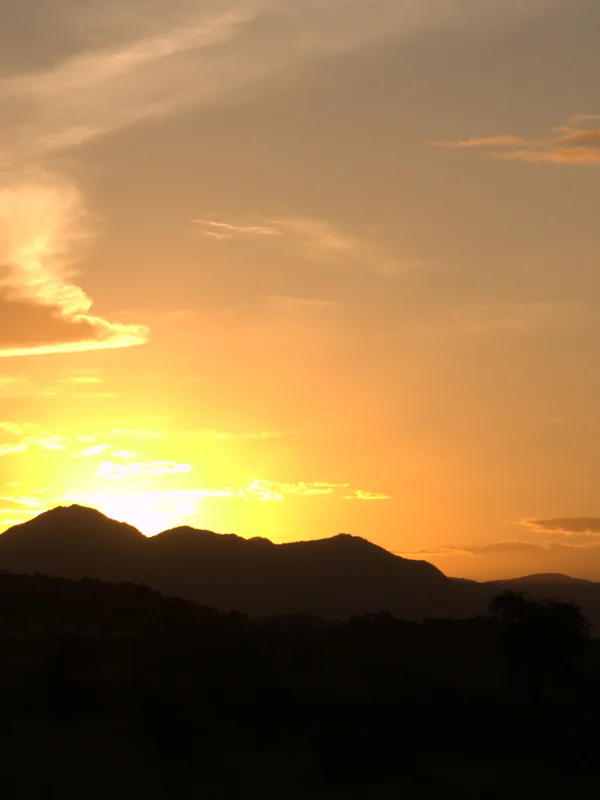
Kidepo Valley National Park sits in Uganda's remote northeastern corner, pressed against the borders of South Sudan and Kenya. It is 1,442 square kilometres of open savanna, rocky outcrops, seasonal rivers, and ancient Karamojong cattle country. Fewer than 3,000 tourists visit each year. For context: the Masai Mara in Kenya receives over 250,000.
That remoteness is not a bug. It is the entire point.
The Animals You Will Not Find Anywhere Else in Uganda
Every national park in Uganda has elephants, buffalo, hippos, and some big cats. Kidepo has all of those, and it also has species found nowhere else in the country.
The presence of ostriches, cheetahs, and bat-eared foxes alone makes Kidepo a destination serious safari-goers should not miss. These animals exist in Uganda only because Kidepo does.
Two Valleys, Two Completely Different Worlds
The park is divided by the Narus River into two distinct landscapes.
The Narus Valley
This is where most game drives happen, and for good reason. The Narus River holds water year-round, drawing animals from across the park and beyond — sometimes from South Sudan. During the dry season (December to March), the concentrations of wildlife around the Narus are extraordinary. Elephant herds of forty or fifty individuals coming down to drink in the evening. Lions spread out in the shade of acacia trees at midday. Zebra, Uganda kob, Jackson's hartebeest, and warthog moving in shifting patterns across the grassland.
Your game drive vehicle may be the only one you see all morning. This is not a modest boast — it is a real and significant difference from parks where vehicles queue at kill sites.
The Kidepo Valley
The valley the park is named for is drier and more remote. In the dry season it can look almost lunar — flat, rocky, with a dramatic horizon of grey and ochre mountains marking the South Sudan border. In the wet season it transforms entirely, filling with green, and with it a different cast of animals. This valley is where you come to understand the scale of the landscape — how big Africa actually is when it is not being managed for crowds.
The Karamojong People
The land around Kidepo is Karamoja — the subregion of northeastern Uganda home to the Karamojong, one of East Africa's last semi-nomadic pastoral communities. Their culture centres on cattle, which function as wealth, identity, and spiritual currency simultaneously.
The Karamojong have lived alongside the wildlife of this landscape for centuries. Their relationship with the land predates the national park by a long way. Visiting the Karamoja Cultural Village near the park entrance offers a genuine encounter with this community — traditional dance, homestead architecture, the oral storytelling tradition — though the quality of these experiences varies and we always vet them in advance for our clients.
What I find most striking about the Karamojong is their sense of ownership of the landscape. They do not relate to the savanna the way a tourist does — as something to observe from a distance. They are of it. That changes how you see the park when you understand it.
Getting There
Kidepo is genuinely remote, and you should accept that before you decide to go. That remoteness is also the reason it is what it is.
By Road
Approximately 840km from Kampala, taking 10–12 hours depending on road conditions. The main route goes via Gulu and Kitgum. Road quality has improved significantly in recent years on the main corridor, but the final stretch into the park is still rough. A Land Cruiser with an experienced driver is non-negotiable. Most road itineraries split the journey with an overnight stop in Gulu (a historic and increasingly interesting city) or Kitgum.
By Charter Flight
A charter flight from Entebbe or Kampala to Apoka airstrip takes approximately 60–90 minutes depending on the aircraft and routing. This is the fastest and most comfortable option, and for clients combining Kidepo with Murchison Falls, a one-way flight in or out makes the itinerary dramatically more efficient. TRVE arranges charter flights as part of all Kidepo packages.
Recommended Minimum Stay
Two full game drive days in the park, meaning a minimum of three nights at Apoka Safari Lodge or equivalent. The journey from Kampala — whichever direction — is long enough that arriving for one game drive and leaving is not a good use of the journey. The park rewards patience: your second full day is almost always better than your first as your eye adjusts to the landscape and the animals become familiar.
Best Time to Visit
- December–March (dry season): Peak wildlife viewing. Animals congregate around permanent water in the Narus Valley. Dusty and hot, but game drive conditions are exceptional. This is when you see the large elephant herds and the best lion activity.
- June–September: Also good. Shorter dry period with green grasses still visible on the plains. The park feels less stark and more photogenic. Cheetah activity is often higher as prey is more spread out.
- April–May and October–November (rainy seasons): Roads become challenging, some sections impassable without the right vehicle. But the park transforms into something dramatically different — green valleys, dramatic clouds, and exceptional birding. Not recommended for first-time visitors.
What a Kidepo Safari Actually Feels Like
In Murchison or Queen Elizabeth, you will share the park with other vehicles. At a lion sighting, five or six vehicles may gather within minutes via radio communication between drivers. It is not unpleasant — you are still seeing a lion — but it is a managed experience in a way that Kidepo is not.
In Kidepo, your guide may call a sighting on the radio and receive silence back. Not because other guides are ignoring it — because there are no other guides within range. You sit with the animals and the landscape and you do not look at other tourists because there are none. The silence is deep and specific and unlike anything you will encounter in a more popular park.
I have watched clients who arrived tired and slightly sceptical about the long journey sit in that silence for twenty minutes without saying a word. Not because there was nothing to say. Because the experience did not need commentary.
Ready for Kidepo?
We run Kidepo as a standalone safari and as part of multi-park itineraries combined with Murchison Falls or Queen Elizabeth. Charter flights, lodge bookings, and Land Cruisers all arranged. Tell us your dates.
View the Kidepo Safari Package Build a Custom Itinerary