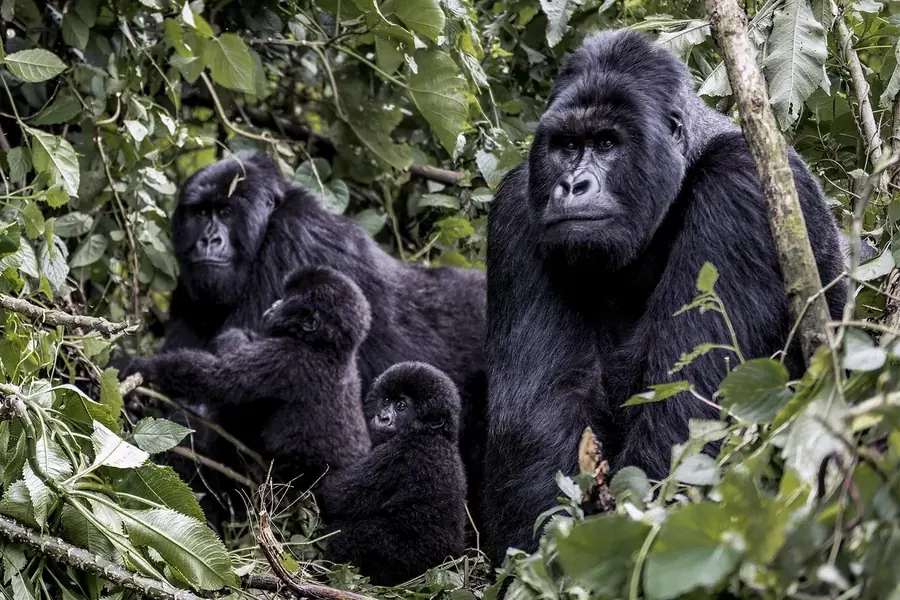
Bwindi Impenetrable National Park is home to roughly 459 mountain gorillas — about half of the entire species left on earth. I have been walking these trails for over ten years. Every single trek still surprises me.
People come to Bwindi with expectations shaped by documentaries. The reality is harder and stranger and more moving than any screen can prepare you for. This guide covers everything you need to know before you book: which sector to choose, how permits work, what to wear, and what actually happens when you find the gorillas.
Why Bwindi Is Unlike Anywhere Else
Bwindi has been a continuous forest for at least 25,000 years. It predates the last ice age. While much of Africa's ancient forest was wiped out during climate shifts, this corner of southwest Uganda survived — which is why it now holds an extraordinary concentration of life, including over 350 bird species and more than 1,000 flowering plant species.
The mountain gorilla (Gorilla beringei beringei) lives in two locations: the Virunga Volcanoes straddling Rwanda, Uganda, and the DRC, and Bwindi. Unlike eastern lowland gorillas, mountain gorillas cannot survive in captivity. The ones you will meet exist nowhere else but in these forests.
In 1981 the global population was estimated at around 250. Conservation efforts — in which Uganda Wildlife Authority, local communities, and organisations like the International Gorilla Conservation Programme have played central roles — have brought that number to over 1,000 today. Your permit fee directly funds this work.
The Four Sectors of Bwindi
Bwindi is split into four sectors. Each has different habituated gorilla families, different terrain, and different lodge options. Which sector you choose changes the character of the experience.
| Sector |
Best For |
Terrain |
Notes |
| Buhoma |
First-timers, all fitness levels |
Moderate |
Most established. Good lodge infrastructure. Closest to Lake Mburo. |
| Rushaga |
Most choice, habituation experience |
Moderate–steep |
6+ habituated families. Only sector offering the 4-hour habituation experience ($1,500). |
| Nkuringo |
Dramatic scenery, serious trekkers |
Very steep |
Remote and spectacular. Not suitable if fitness is a concern. Outstanding views. |
| Ruhija |
Quieter visits, birders |
Moderate |
Fewer visitors. Also excellent for birding — over 350 species in Bwindi. |
My recommendation for most first-time visitors is Buhoma or Rushaga. If you are fit and want something more remote and challenging, Nkuringo will give you a trek you talk about for the rest of your life — but you will feel it the next morning.
Permits: Cost, Booking, and Timing
A standard gorilla trekking permit in Uganda costs $800 USD per person. This is non-negotiable — it is set by Uganda Wildlife Authority (UWA) — and it covers the guided trek, ranger escort, and your one hour with the gorilla family.
If you want a deeper experience, the gorilla habituation permit costs $1,500 per person and gives you four hours with a gorilla family that is still being acclimatised to human presence. It is available only in Rushaga. The four hours are very different from the standard one hour — less predictable, often more physical, and extraordinary if you have the patience for it.
Permit Booking Tips
- Book 6 to 12 months in advance for June–August and December–January (peak seasons).
- Shoulder seasons (March–May, September–November) have more availability and lower accommodation prices.
- Each gorilla family receives a maximum of 8 visitors per day.
- Permits can be booked directly through UWA or through a licensed tour operator like TRVE — we handle all permit logistics for clients on our packages.
- Minimum age for gorilla trekking is 15 years.
How Fit Do You Need to Be?
Honestly assessed: most reasonably active adults can do it. But "reasonably active" means you can walk uphill for 2–4 hours. The question is not whether you can finish the trek — rangers will wait for you — but whether you will enjoy it.
The rangers use a 1–5 difficulty scale for each family, based on where the GPS tracker showed them that morning. A rating of 2 means a short, relatively flat walk. A rating of 5 means several hours of steep climbing through dense vegetation. You don't know your rating until the morning briefing, so the honest answer is: be prepared for a hard day.
The single best thing you can do is hire a porter. They cost around $20 and carry your day pack. On the steep descents they also become a second pair of hands — literally gripping your wrist on a mud slope. People who decline the porter almost always wish they hadn't by hour three.
What to Wear: The Field-Tested Kit
After a decade of watching trekkers arrive underprepared, here is what I tell every client the night before:
Clothing
- Long trousers — not shorts. The forest has stinging nettles that will cut through bare legs in seconds. Convertible zip-off trousers work well.
- Long-sleeved shirt — again, nettles and the cold of the early morning at altitude.
- Waterproof rain jacket — Bwindi gets rain even in dry season. A light packable shell is enough.
- Neutral colours — brown, khaki, olive, grey. Avoid bright colours and pure white (dust). Avoid black if possible (heat).
- No perfume or cologne — gorillas have strong smell and human scents can unsettle them.
Footwear
Waterproof hiking boots that you have already broken in. This is the most important equipment decision. New boots mean blisters by hour two. Wear your boots on several walks in the weeks before your trip. Trail runners are acceptable in dry season for fit trekkers; not recommended in wet season.
Gardening Gloves — The Item Nobody Packs
This is the one thing almost every trekker wishes they had. Not expensive hiking gloves — cheap rubber-grip gardening gloves. Nettles cut straight through most glove materials except rubber grip. When you are grabbing vegetation to pull yourself up a steep slope in Nkuringo, gardening gloves are the difference between a comfortable hand and one covered in nettle stings for three hours. Bring them. They cost almost nothing.
The Day of the Trek
Your briefing at UWA headquarters starts at 7:30–8:00am. Meanwhile, a team of trackers has been in the forest since before dawn using GPS data from the previous evening to locate where the gorilla family slept. By the time you receive your briefing and set off, the trackers are already with the family, waiting.
After the briefing you are assigned to a group (maximum 8 people) and an experienced ranger guide. You set off on foot. Trek duration is genuinely unpredictable — it depends on where the family is. It can be 40 minutes. It can be 6 hours. Eat a proper breakfast. Bring at least two litres of water and some energy snacks.
When the ranger signals that you are close, the group slows and silences. You may hear the gorillas before you see them — low grunts, the sound of vegetation being broken as they move through the undergrowth.
"The moment you see the first gorilla — and then realise there are eight more just behind it — nothing you have read or watched quite prepares you for what happens to your breathing."
— Michael Wamani, Senior Guide
The One-Hour Rule
Your time with the gorilla family is exactly one hour. This is not arbitrary — it is mandated by the International Gorilla Conservation Programme and Uganda Wildlife Authority to protect the gorillas from stress and from human respiratory illness, to which mountain gorillas are dangerously susceptible.
The minimum approach distance is 7 metres. In practice, gorillas sometimes come closer of their own accord. When this happens, step back calmly and avoid eye contact with the silverback. Do not run, do not point directly at them, and follow your ranger's instructions immediately.
One hour sounds short. When you are standing 10 metres from a 200kg silverback who is watching you with the quiet intelligence of something that shares 98% of your DNA, you will not be counting minutes.
What the Gorillas Actually Do
Mostly, they eat. An adult gorilla consumes 18–25kg of vegetation per day. You will watch them pulling apart bamboo, stripping bark, foraging methodically through the undergrowth. The young ones — the most entertaining to watch — will chase each other, climb on their mothers, occasionally stage a show-off chest-beat attempt.
The silverback usually sits slightly apart from the family, observing. He is the one in charge of every movement decision the group makes. If he stands and begins moving, the whole family moves with him. If he settles, they settle. Watch him for long enough and you will understand that his role is less about aggression and more about constancy — a steady anchor the others navigate around.
The sounds stay with you. Low rumbling contentment vocalisations. The sudden crack of a branch. The wet, rhythmic sound of chewing. These are not zoo sounds. This is the forest, and the gorillas are completely at home in it.
Best Time to Visit Bwindi
Gorilla trekking is possible year-round — the gorillas are always there. The question is what kind of experience you want and what you are willing to pay.
- June–August: Peak dry season. Best trail conditions, easiest walking. Most popular — book permits very early. Highest accommodation prices.
- December–February: Second dry season. Also popular, particularly over Christmas and New Year.
- March–May: Long rains. Trails are muddy, conditions are harder. But permits and lodges are cheaper, the forest is intensely green and photogenic, and you share the experience with far fewer people.
- September–November: Short rains. Similar to March–May — good availability, lush vegetation, more challenging trekking.
My personal preference: the end of the rainy season in late May or early November. The trails are drying out, the forest is at its most dramatic, and there are very few other visitors.
Ten Tips from a Decade on These Trails
- Hire the porter. Every single time. No exceptions.
- Eat a proper breakfast at the lodge before you leave. You may not be back until 3pm.
- Charge your camera the night before. Cold mountain mornings drain batteries faster than you expect. Bring a spare.
- Pack gardening gloves — not hiking gloves. Rubber grip, from any hardware shop.
- Wear gaiters in wet season. They keep your boots dry and your ankles nettle-free.
- Leave cologne and perfume at the lodge. You are not going to a restaurant.
- Turn off camera flash. It is prohibited, it upsets gorillas, and flash ruins forest photography anyway. Use ISO.
- Do not whisper for the sake of it. Normal quiet speaking is fine. Sudden noises are not. Follow your ranger's lead.
- Ask your ranger to show you last night's gorilla nest on the return walk. They build a new one each night from bent branches. Remarkable to see.
- Give yourself two nights in Bwindi minimum. One night means rushing. Two nights means you arrive in the afternoon, rest, trek in the morning, and leave the following day without pressure.
Ready to Trek?
We handle permits, lodge bookings, Land Cruiser transport, and all logistics — so you just show up and walk. Tell us your dates and group size and we'll build the itinerary.
View the Gorilla Explorer Package
Get a Custom Quote

Michael Wamani
Senior Safari Guide · TRVE
Michael has been guiding safaris across Uganda since 2014, with a specialism in primate tracking in Bwindi and Kibale. He has walked the Bwindi trails in every season and with every kind of traveller. He writes about what he has actually seen, not what the brochures say.